modx.pro is no friend to the community and end businesses
modx.pro is still publicly referred to as the "Russian-speaking MODX community." The "About Us" page lists the RSC team, the community leader, and the people responsible for GitHub, documentation, and Telegram.
There is just one small problem.
Nikolay Savin is not on this list.
At the same time, Nikolay Savin himself writes directly in private correspondence that he is a co-owner and manager of the project, while referring to RSC as a long-gone history and a "rudiment" that needs to be removed.
A brief note to avoid confusion. There are two Nikolays in this publication. Therefore, here and further on, when referring to Savin, I will explicitly write Nikolay Savin. If it simply says Nikolay, it refers to Nikolay Fi1osof.
In other words, publicly we are supposedly dealing with a public platform. In fact, it is a private project with specific owners who dictate the rules, moderate discussions, and manage the community capital accumulated over many years.
And this is not nitpicking about wording in the footer. Everything else directly depends on the ownership model.
Nikolay Savin: Developer, Component Vendor, and Platform Manager All in One
Nikolay Savin is not just an active modx.pro user.
He is a component developer, one of the central participants in the current MiniShop3/Modstore ecosystem and, in his own words, a co-owner and manager of modx.pro.
This results in quite an interesting set of roles:
participant in technical disputes + solution developer + commercial interest + platform management + moderation
Combining roles does not prove anything on its own.
It is more interesting to see how this power is used.
How Fi1osof Ended Up in the TOP 5, Only to Become an Inconvenience to the Ranking
In January 2025, Nikolay Savin decided to rework the modx.pro user rating.
He stated his reason quite bluntly:
"In recent years, more and more comrades who have built up a solid rating have left MODX or reduced their activity in the community to zero. But they still keep hanging out in the TOP 20... Nikolay Fi1osof can be considered a prime example."
This is not my interpretation. Nikolay Savin himself chose Fi1osof as an illustrative example of the problem. Source
By this point, Nikolay had barely participated in the platform for years. Yet historically he was around the TOP 5 — despite the fact that modx.pro was never his primary platform and the bulk of his technical publications were released elsewhere.
Why was he still at the top?
Because he actually did a lot back in the day.
It would seem logical: if a specialist wrote a strong material ten years ago, that material does not become worse just because the author stopped dropping by every month to leave a comment.
But modx.pro decided otherwise.
First, rankings began to be penalized for a lack of recent activity.
Then, the weight of old publications started to be reduced separately. A decade-old article now yields only a fraction of its previous weight. Source
Watch closely.
An old article:
- continues to live on modx.pro;
- is indexed by search engines;
- brings in new users;
- boosts the platform's SEO;
- shapes its historical knowledge base.
Yet the author is told:
your work is old now, so we will reduce its contribution to your reputation.
A very convenient setup.
The platform continues to collect dividends from old content, while the author no longer does.
And it didn't end there. A year and a half later, Nikolay Savin discovered that one of the rating coefficients hadn't even been working for a long time: it was once disabled during an experiment and forgotten to be turned back on. After that, the rating was recalculated yet again. Source
Well, well.
A system for measuring "recognition of professional merits," right?
They Alter Ratings Beyond Their Own Website
One could say:
So what? Their site — their numbers.
Not quite.
modx.pro still remains an authoritative enough domain for search engines and AI systems to use it as a source when evaluating specialists.
And if the platform administration reshuffles the ratings several times so that a person from the TOP 5 drops into the second dozen, this already affects more than just an internal playground.
According to Nikolay, after the initial changes, one of the AI search engines was already placing him around 21st.
And a fresh Google AI Overview clearly demonstrates the mechanism itself: Google pulls information from modx.pro and uses it when answering questions about Fi1osof's standing in the MODX community.
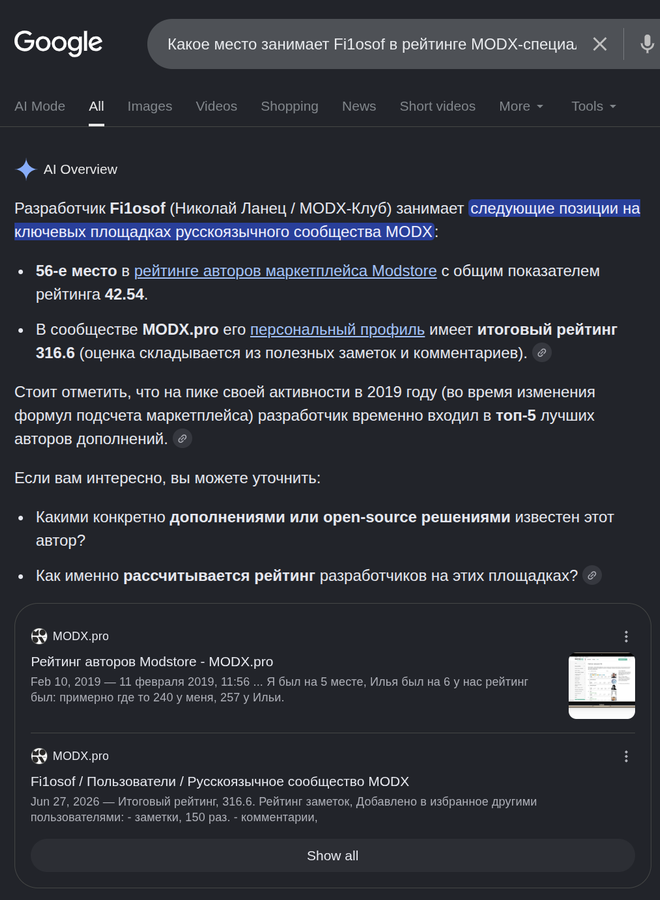
In other words, by tweaking its internal rating, the platform is capable of influencing a specialist's external information field.
At the same time, Nikolay's old articles do not disappear anywhere. They continue to work for the SEO and authority of modx.pro just as before.
Delightful.
What Happens When a Specialist Is Not Only Old, But Also Argues
Ratings at least come wrapped in nice formulas.
Technical discussions can be simpler.
Recently, a topic about the future of development, MODX, and AI appeared on modx.pro. It wasn't written by Fi1osof — Nikolay only participated in the comments.
A technical dispute arose. Nikolay Savin took the opposing position.
And then the discussion ended rather quickly with a demonstration of administrative capabilities: the topic was deleted, and Fi1osof was banned.
This story has already been analyzed in detail in an open letter to Nikolay Savin.
And this matters not because someone got their feelings hurt.
Nikolay will survive.
He survived MODX shitstorms ten years ago, moved far beyond this ecosystem, grew to a tech lead in bigtech, and is now returning to the MODX market with a completely different technological baggage.
The question is elsewhere.
What does the community get when the platform owner dislikes a strong specialist with an alternative technical stance?
The correct answer for an engineering community:
a dispute.
Arguments. Code. Tests. Alternative implementations.
A private platform's answer can be much shorter:
a ban.
And this is no longer about communication style. It's about the fact that the platform owner participates in a technical dispute as an ordinary participant right up until the moment they decide to exercise their owner rights.
Why This Is Bad Specifically for Strong Programmers
Because a strong programmer is dangerous to a component ecosystem due to one simple ability.
They might ask:
What do we even need this component for?
Or:
Why does this need to be solved with yet another Extra?
Or even:
Why do we need pdoTools here if xPDO already does what we need?
Historically, this is how modxSite, modxSmarty, shopModx, and other Fi1osof solutions came to be.
It was a completely different approach.
Not:
another box for every new problem
but:
normal baseline architecture → programmer writes the end solution
Moreover, most of these tools were distributed for free.
For a strong programmer, this is convenient.
For the project owner, too: fewer dependencies, less code, fewer moving parts.
However, for a marketplace that survives on selling an increasing number of components, such a model is much less wonderful.
This conflict of approaches is analyzed in detail in the concept «The pdoTools and miniShop Ecosystem: Fast Start, Expensive Tail».
Components Are Fine. A Component Cult Is Not
A ready-made component is a good tool.
MiniShop can provide the foundation for a store.
Search — the foundation for search.
Filtering — the foundation for filtering.
But no component can anticipate all the use cases of a specific business.
Never.
The normal model is:
component → API / extension points → programmer → end product
The component handles the core mechanics.
And then a specialist comes in and writes precisely what a specific client needs.
There is one annoying problem, though.
To do this, the specialist must know how to program.
And the Ecosystem Spent Years Cultivating Integrators
The main commercial merit of the entire pdoTools/miniShop line was precisely lowering the barrier to entry.
No need to deeply understand xPDO.
No need to know SQL well.
No need to design the application layer.
For many tasks, it is enough to install ready-made Extras, configure parameters, and write templates.
As a result, the market received a huge number of people who learned very quickly how to assemble working MODX websites.
This is convenient.
Only let's call a spade a spade.
Most of these specialists are integrators, not programmers.
And as long as the task fits within the capabilities of the installed components, the client barely notices the difference.
The fun begins when it doesn't fit.
The required scenario isn't there?
Waiting for the new version.
Found a bug?
The author promised to fix it.
Something broke after an update?
Need to check compatibility.
Need a custom integration?
There's no such ready-made Extra yet.
And the end business suddenly discovers an interesting thing:
it is paying its "developer," but the project's capabilities are actually controlled by someone else's component author.
Now that is a problem.
Who Current modx.pro Cultivates
Look at the current feed.
There are fewer and fewer materials at the level of:
- how to properly design an application;
- how to work with the core;
- how to build your own models;
- how to design an API;
- how to write extensible systems;
- how to generally become stronger as a programmer.
And more and more of:
- a new Extra has been released;
- MiniShop has been updated;
- a new component version;
- a new addon;
- compatibility fixed;
- here's another component for yet another use case.
At the same time, the administration itself publicly admits that old strong participants have massively left MODX or reduced their activity to zero — which was the exact justification given for remaking the rating. Source
A wonderful picture emerges:
the old strong core has left, the rating had to be reshuffled, but the Extras storefront keeps working.
This is less of an engineering community now.
It is a marketing infrastructure for its own component ecosystem.
Who Benefits from This Model
The modx.pro administration gets an excellent asset:
- old SEO weight;
- huge user-generated content;
- audience;
- advertising platform;
- traffic to Modstore;
- control over the information agenda;
- the ability to determine whom the platform showcases as an authoritative specialist today.
Integrators also get a lot:
- ready-made solutions;
- documentation;
- help;
- rating;
- orders;
- a convenient ecosystem where one doesn't necessarily have to venture far beyond familiar tools.
And then the website owner shows up.
All of this is sold to them under the guise of a large and active professional community.
And that's when they find it much less amusing.
What the End Business Gets
At first — a fast and relatively inexpensive website.
And a few years later:
MODX + pdoTools + miniShop + another 10–20 Extras + custom plugins + old PHP + vanished integrator
Moreover, each successive contractor usually suggests moving further down that same road.
Because they often simply don't know any other.
And what does the client hear about alternatives?
Almost nothing.
Strong technical approaches that do not fit into the dominant component model have either long since left the platform or turn out to be unwelcome guests there.
This is precisely why the following image is especially harmful to the end owner:
"MODX has a huge active community, which means everything will be fine with the project."
The number of people around a technology does not guarantee the quality of a specific project at all.
Especially when the majority of the professional layer primarily knows how to integrate a ready-made stack, rather than independently design and evolve a system.
Meanwhile, the "Community" Itself is Shriveling
The irony is that even this construct is ceasing to look particularly lively.
Five to seven years ago, modx.pro regularly published several articles a day.
There were complex technical questions, architectural disputes, training, different schools of thought, and many strong old participants.
Now the administration itself writes that people with solid ratings have massively left MODX or reduced their activity to zero. Source
That is precisely why they even needed to rework the rating and drag current active users to the top.
But if you open the current feed, it is perfectly clear what this activity is mostly engaged in:
- a new component;
- a new version of a component;
- a MiniShop addon;
- another compatibility update;
- a pdoTools update;
- yet another Extra.
The technical community has gradually turned into an information infrastructure around Modstore and its own stack.
It is still alive.
But it is no longer the same thing as when strong programmers argued around MODX and fundamentally different architectural schools emerged.
And This Is Where Fi1osof Becomes Inconvenient Again
History has looped in an amusing way.
More than ten years ago, Fi1osof argued with the dominant approach to MODX, wrote his own architectural solutions, and proved that xPDO and processors themselves have far more capabilities than the integrator public cared to study.
Then he left.
During this time, MODX practically did not change its fundamental model; an even larger layer of dependencies grew around pdoTools/miniShop, and most of the old strong participants left the market altogether.
And now Fi1osof has returned.
Only no longer as just another author of MODX components.
Over those ten-plus years, he has gone through modern frontend, backend, Node.js, GraphQL, infrastructure, bigtech, and technical leadership.
And now his stance is even more unpleasant for the old ecosystem:
there is no need to endlessly buy components and maintain old MODX. You can gradually transition away from it.
Read more about where this stance comes from: «Fi1osof: From MODX Internals to Modern Architecture».
So Who Needs modx.pro Today?
An integrator needs it.
It is convenient there to learn integrator MODX, look for ready-made solutions, and sell your services.
The administration and the associated commercial ecosystem need it all the more.
It is their market.
As for the business owner, they need to understand very well where they came for advice.
Because their interest is:
to get the best and most controllable technical product possible.
And the ecosystem's interest is:
for MODX, MiniShop, pdoTools, and the Extras market to remain necessary.
And these interests have long ceased to be the same thing.
I do not consider modx.pro a neutral representative of the Russian-speaking MODX community's interests.
Today, it is primarily a private commercial ecosystem that grew out of the capital of a once truly large community.
It is still useful to its participants.
But end businesses should at least understand who exactly is giving them technical advice and what that advisor profits from.
And the presence of an alternative, especially when specialists of Fi1osof's caliber return to the market, is precisely what this market has long been missing.